

Dr. Kranti K. Srivastava
Director, Prasad Pscycho Pvt Ltd
20 min read
November 20, 2026
Introduction
Entrepreneurial success is usually told as a story of ambition, hustle, and financial results. Behind every launch, pivot, and hard-won milestone is something less visible: a human mind working under pressure.
Founders live with uncertainty. They make high-stakes decisions with incomplete information, regulate their emotions through setbacks, motivate teams when the path is unclear, and try to protect their own well-being while building something from nothing. This is why psychology offers so much insight into why some entrepreneurs turn challenges into growth while others are overwhelmed by stress and burnout.
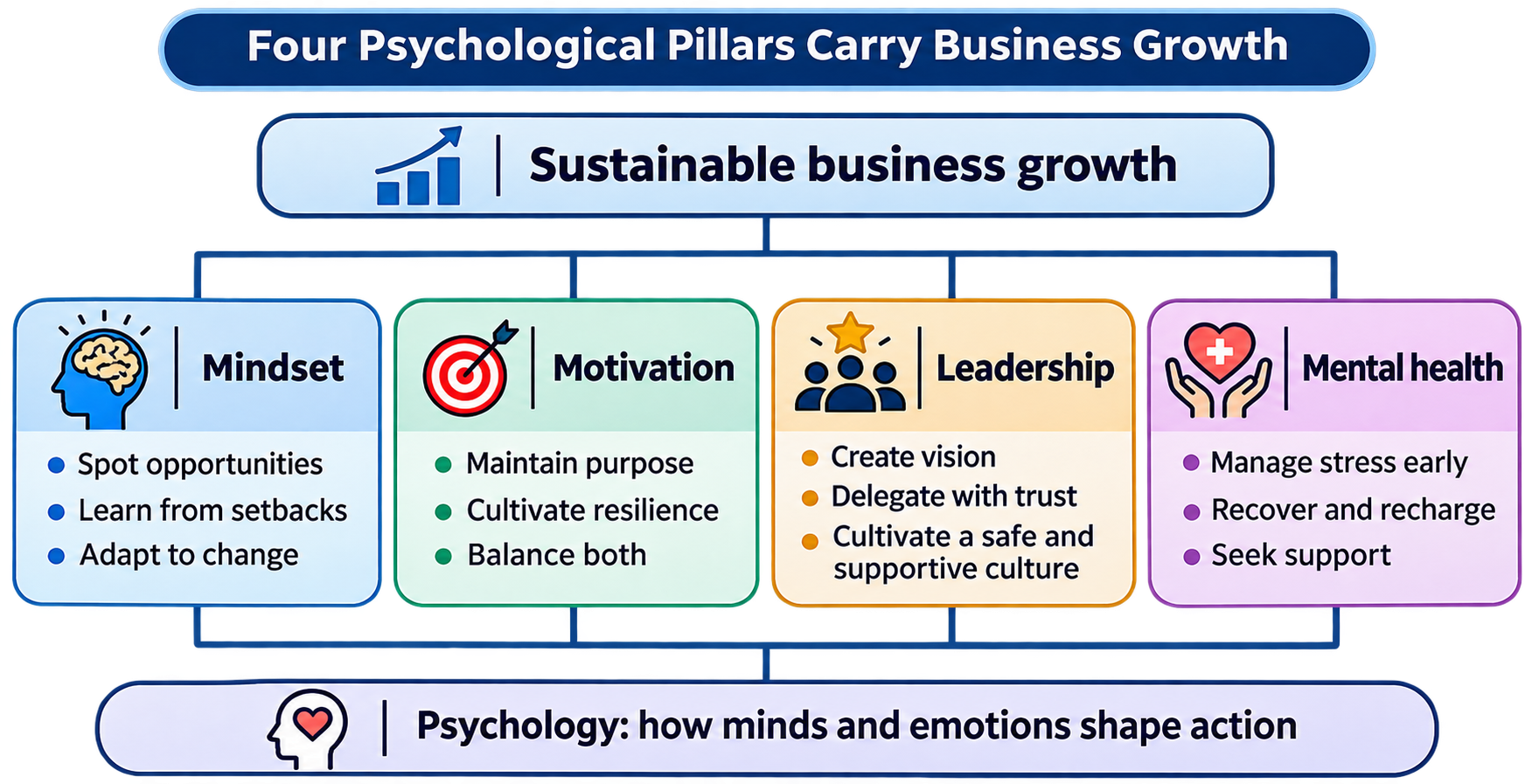
This article looks at the four psychological pillars of entrepreneurial success (mindset, motivation, leadership, and mental health) and ends with a practical, seven-step framework you can apply to your own business.
Four psychological pillars carry business growth
Understanding the Foundation: Psychology and Mental Health
Psychology is the scientific study of the human mind and behavior. It examines how thoughts, emotions, memories, motivations, relationships, and environments shape the way people act. The discipline moved toward experimental science in 1879, when Wilhelm Wundt established the first formal psychology laboratory, and the American Psychological Association was founded in 1890. Since then, the field has built a large body of knowledge about decision-making, motivation, stress, and leadership, all of which matter to anyone building a business.
Mental health refers to a person’s emotional, psychological, and social well-being. It influences how we handle stress, relate to others, make choices, and pursue goals.
In entrepreneurship, mental health is not a “soft” issue. It directly affects focus, creativity, decision-making, relationships, productivity, and long-term business performance.
A founder who is depleted makes weaker decisions, and a business depends heavily on the quality of those decisions.
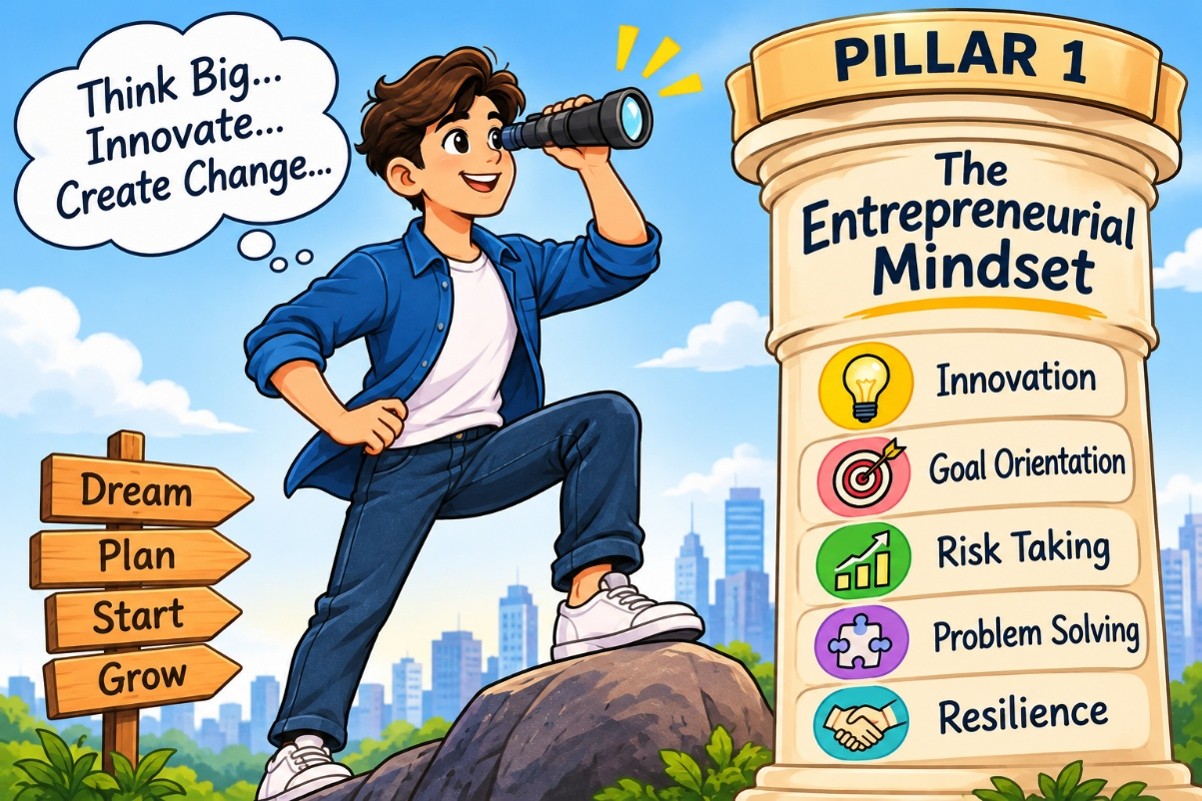
PILLAR - 1
The Entrepreneurial Mindset
An entrepreneurial mindset is a way of thinking that helps founders recognize opportunities, adapt to change, take calculated risks, and learn from setbacks. It combines self-belief, resilience, curiosity, and creativity with a willingness to act even when outcomes are uncertain.
The clearest difference between mindsets shows up in how founders treat failure. Entrepreneurs with a growth-oriented mindset do not see failure as a final judgment. They see it as feedback. A product that does not sell, a rejected pitch, or a negative customer review becomes information that improves the next decision.
Six core mindset strengths
- Opportunity recognition: noticing customer needs and gaps in the market.
- Self-efficacy: believing that effort and skill can influence results.
- Adaptability: changing plans when new information appears.
- Resilience: recovering from rejection, losses, and uncertainty.
- Learning orientation: treating mistakes as lessons rather than personal failures.
- Long-term thinking: making decisions that support sustainable growth, not just short-term wins.
The key point is that these strengths can be developed. Mindset is not a fixed trait that founders either have or lack. Habits of reflection, feedback, and deliberate practice shape it.
PILLAR - 2
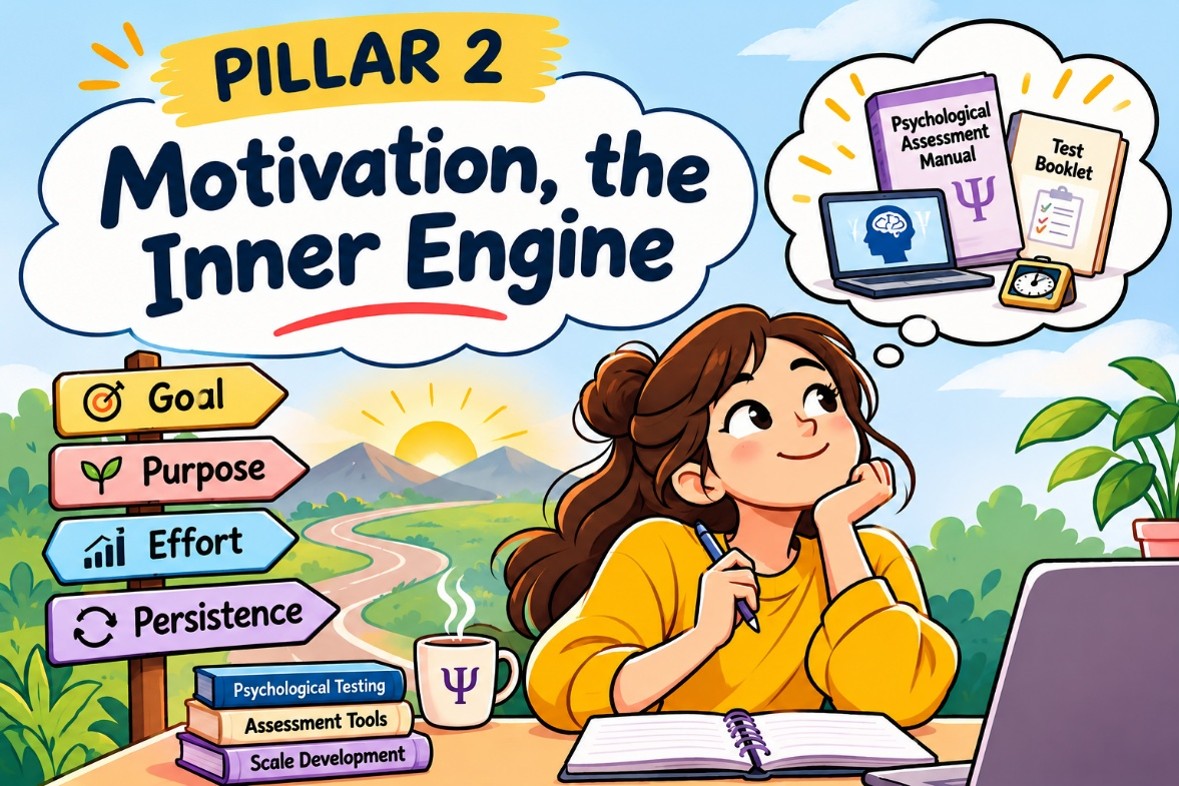
Motivation, The Inner Engine
Motivation is the psychological energy that keeps entrepreneurs moving after the initial excitement fades. Starting a business can feel inspiring, but sustaining one takes purpose, discipline, and the ability to keep going through slow growth, financial pressure, and repeated setbacks.
Entrepreneurs are commonly driven by a need for achievement, independence, creativity, autonomy, and a desire to solve meaningful problems. These drives support persistence, but they work best when balanced with realistic expectations and healthy boundaries.
Intrinsic vs. extrinsic motivation
| Type of motivation | What drives it | Entrepreneurial example |
|---|---|---|
| Intrinsic | Purpose, curiosity, mastery, autonomy, and personal meaning | Building a product because it solves a real customer problem |
| Extrinsic | Money, recognition, status, competition, or external approval | Working harder to reach a revenue target or gain industry recognition |
Intrinsic motivation is usually more sustainable because it is tied to personal values and meaningful work. When the market is quiet and the bank balance is tight, purpose is what keeps a founder showing up.
Extrinsic motivation is not a problem in itself. It can be very useful, especially when tied to clear goals and milestones. The risk comes when it becomes the only reason for building the business, because external rewards are unpredictable and can disappear.
A healthy approach is to know what drives you. Ask whether you are motivated by purpose, achievement, autonomy, financial security, or a mix, and check regularly that your daily work still connects to the reasons you started.
PILLAR - 3
Leadership, From Vision to Action
Leadership is the ability to turn a vision into coordinated action. Entrepreneurial leaders communicate direction, build trust, delegate responsibility, make decisions under uncertainty, and create an environment where team members can do their best work.
Research describes entrepreneurial leadership as an approach centered on opportunity recognition, value creation, and team empowerment. It is not only about spotting opportunities yourself, but about enabling others to act on them.
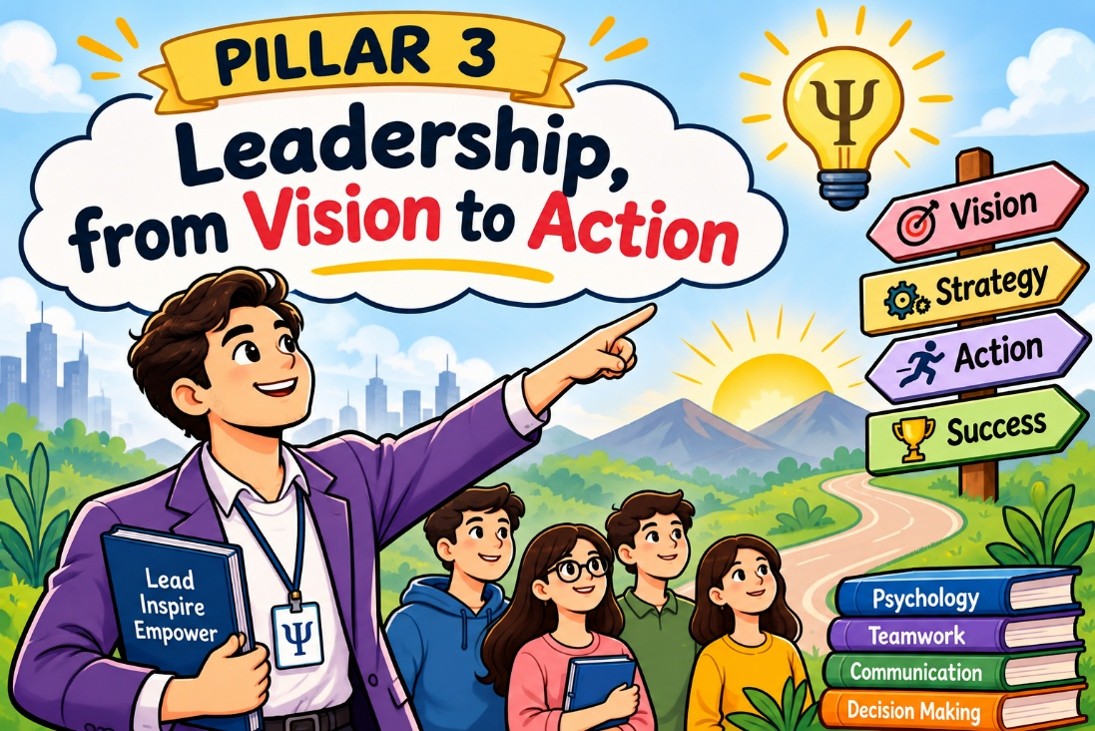
Leadership behaviors that support growth
- Communicate a clear vision and explain why the work matters.
- Set measurable goals and connect them to daily priorities.
- Delegate meaningful responsibility instead of controlling every task.
- Give constructive feedback and recognize progress.
- Listen to employees, customers, and market signals.
- Make decisions using both data and judgment.
- Build a culture where people can raise concerns without fear.
That last behavior is often underestimated. When people feel safe raising problems early, small issues are caught before they become expensive ones.
Strong leadership is not about doing everything alone. It is about building systems, developing people, and creating a business that can perform beyond the founder’s personal capacity. A company that depends entirely on one exhausted person cannot scale.
PILLAR - 4
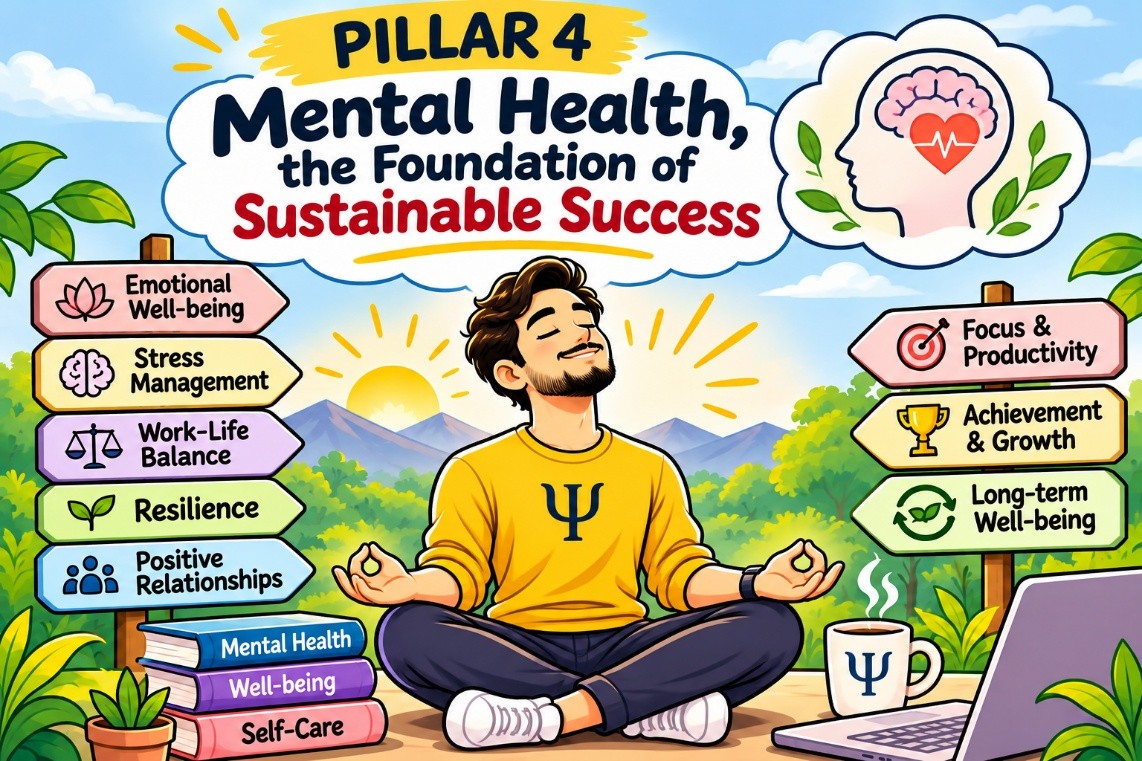
Mental Health, The Foundation of Sustainable Success
Entrepreneurship can be deeply rewarding, but it often involves long hours, financial insecurity, isolation, heavy responsibility, and constant uncertainty. When these pressures are not managed, they can contribute to stress, anxiety, exhaustion, and burnout.
Burnout is a state of physical and emotional exhaustion caused by prolonged stress. Research on entrepreneurs links burnout with negative emotions, anxiety, poor work-life balance, and over-engagement. Protective factors include resilience, self-efficacy, positive emotions, and healthy engagement with work.
Warning signs entrepreneurs should notice
- Persistent exhaustion that rest does not fix
- Difficulty concentrating or making decisions
- Increased irritability, anxiety, or emotional numbness
- Loss of interest in work that once felt meaningful
- Sleep problems or frequent physical tension
- Isolation from friends, family, and support networks
- Feeling trapped by the business rather than empowered by it
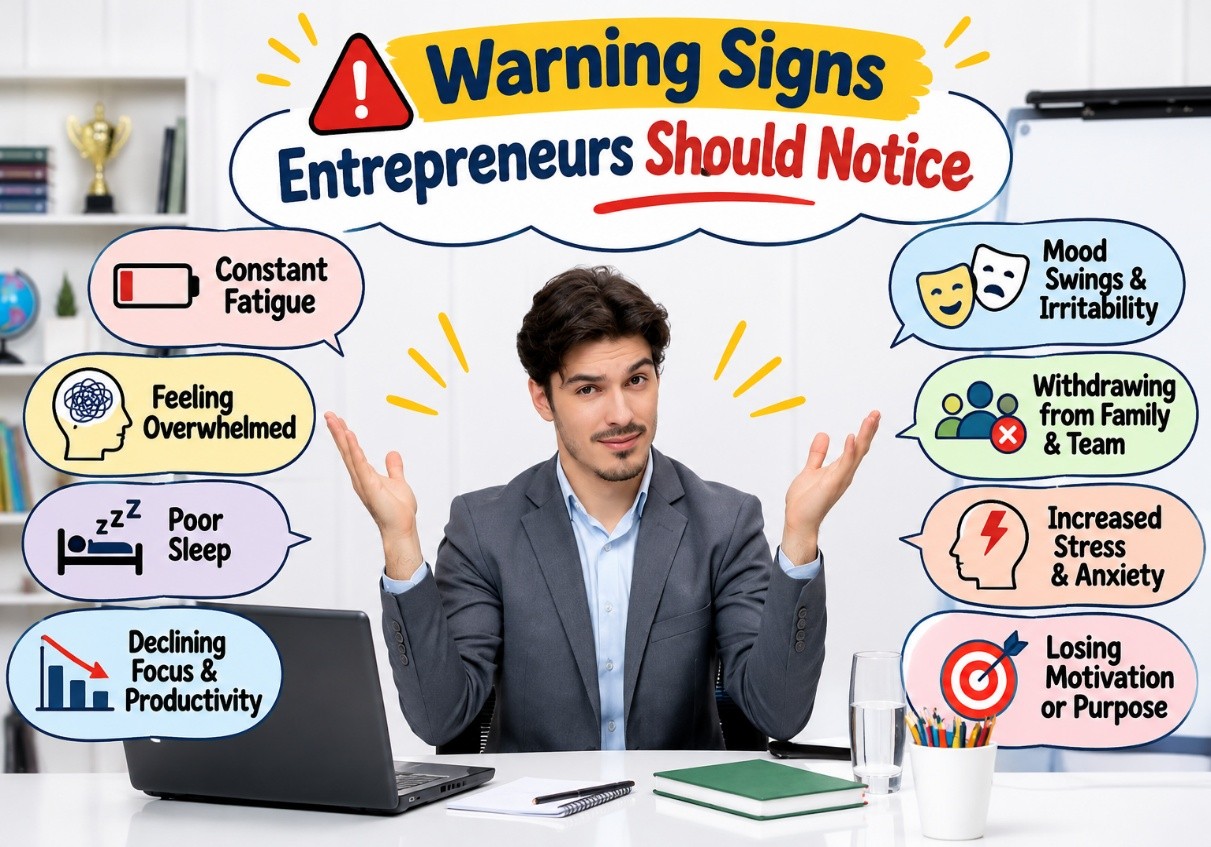
Noticing these signs early is not weakness. It is the same kind of monitoring a founder would apply to cash flow or customer churn. If several of these signs persist, speaking with a mental-health professional is a sound business decision as well as a personal one.
Building Psychological Resilience
Resilience is the ability to recover from difficulty and continue moving forward. It does not mean ignoring stress or forcing yourself to work harder. It means recognizing pressure, managing emotions, seeking support, and taking practical next steps.
Research suggests that relaxation and a sense of control are strongly associated with entrepreneur well-being, and that a sense of control is also strongly associated with lower burnout. This is why resilience-building focuses so much on what you can influence.
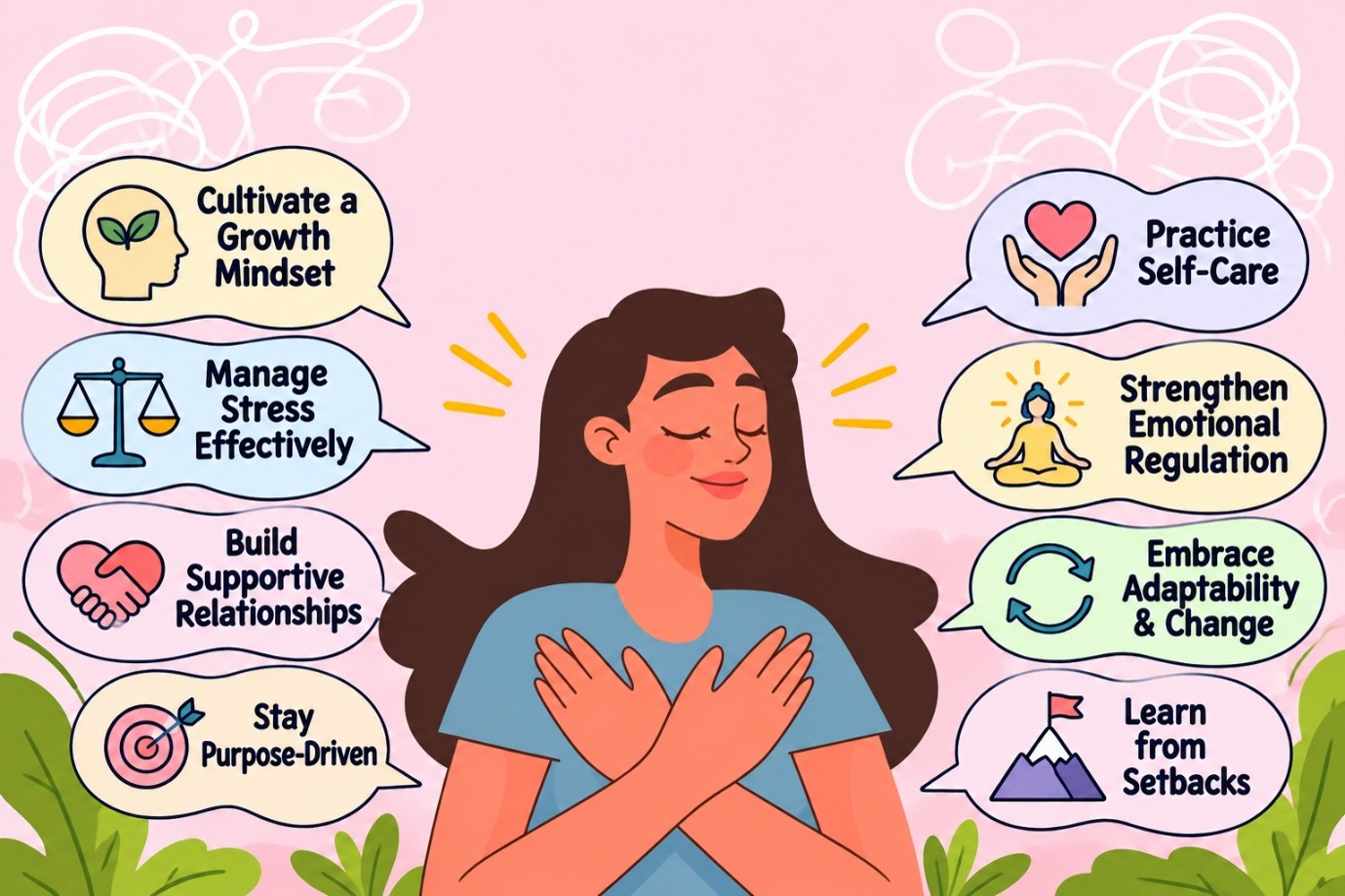
Practical resilience habits
- 1. Separate business setbacks from personal worth. A failed strategy is not a failed founder.
- 2. Use short feedback cycles. Test ideas quickly so problems surface early.
- 3. Schedule recovery time as seriously as meetings and deadlines.
- 4. Maintain relationships outside work to reduce isolation.
- 5. Ask for support from mentors, peers, coaches, or mental-health professionals.
- 6. Focus on controllable actions such as customer conversations, product improvements, and financial planning.
- 7. Set boundaries around working hours, notifications, and personal time.
A Psychology-Based Growth Framework
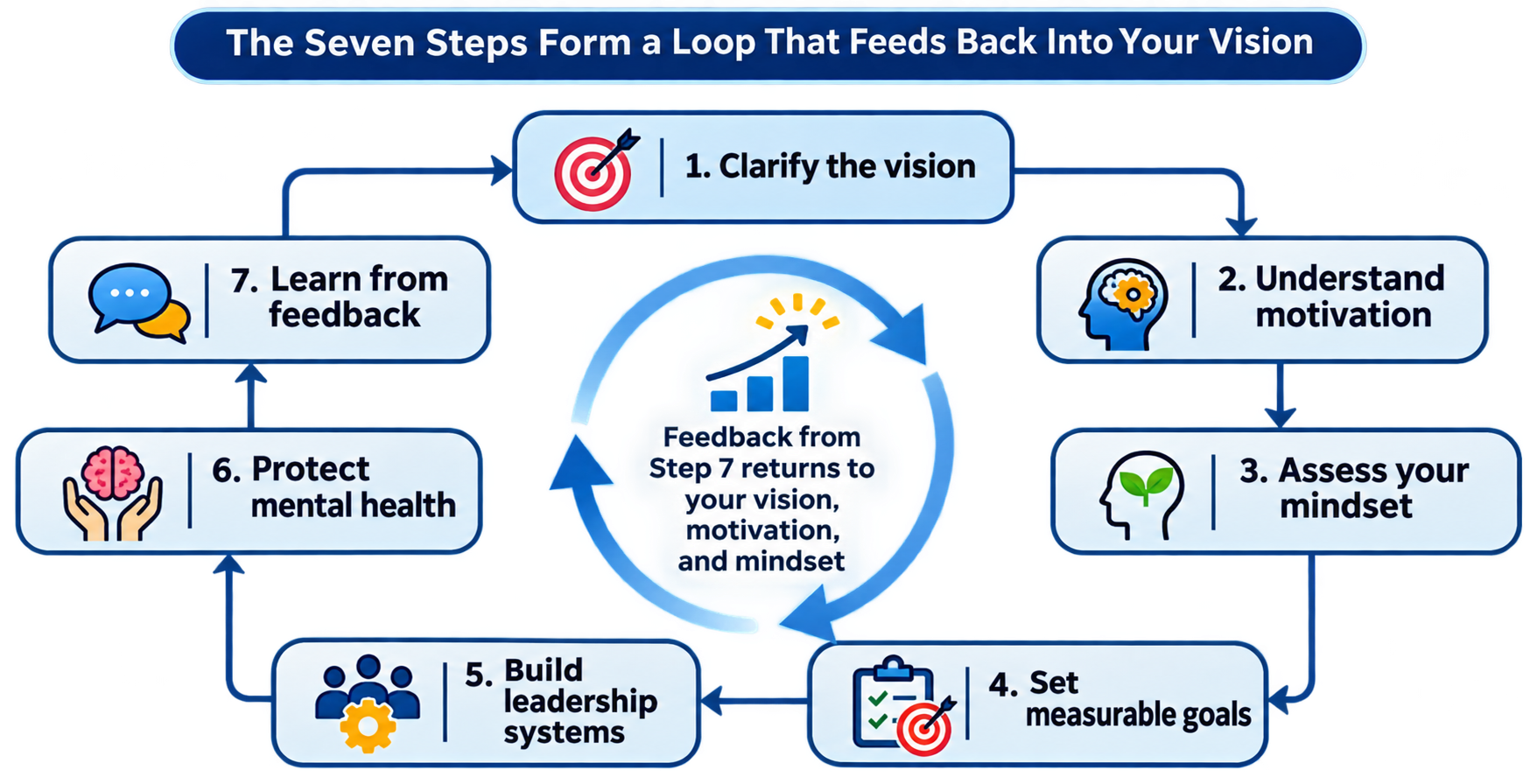
Entrepreneurs can turn these insights into practical business growth by following a structured process:
- 1. Clarify the vision. Define the problem you want to solve and the impact you want to create.
- 2. Understand your motivation. Identify whether you are driven by purpose, achievement, autonomy, financial goals, or all of these.
- 3. Assess your mindset. Notice limiting beliefs and replace them with learning-focused alternatives.
- 4. Set measurable goals. Break large ambitions into weekly actions and clear performance indicators.
- 5. Build leadership systems. Delegate tasks, clarify roles, and create accountability.
- 6. Protect mental health. Monitor stress, maintain recovery routines, and seek support early.
- 7. Learn from feedback. Use customer responses, team input, and business data to improve continuously.
The framework works as a cycle. Feedback from step seven feeds back into your vision, motivation, and mindset, so the process keeps improving as the business grows.
Frequently Asked Questions
Is entrepreneurial success mostly about talent or psychology?
Skills, capital, and market timing all matter, but psychological factors such as resilience, adaptability, and self-efficacy shape how well a founder uses those resources, especially under pressure.
Can an entrepreneurial mindset be learned?
Yes. Habits like reflecting on failures, seeking feedback, and testing ideas in small steps strengthen a growth-oriented mindset over time.
How do I know if I am heading toward burnout?
Watch for exhaustion that rest does not fix, difficulty concentrating, emotional numbness, loss of interest in your work, and withdrawal from the people around you. If these persist, seek support early.
Which motivation is better, intrinsic or extrinsic?
Intrinsic motivation tends to be more sustainable, while extrinsic motivation can help with clear goals. The healthiest approach combines both without relying on extexrnal rewards alone.
Final Thoughts
The psychology of entrepreneurial success is not about pretending everything is easy. It is about developing the mindset to face uncertainty, the motivation to stay committed, the leadership to guide others, and the mental-health awareness to sustain performance over time.
A successful entrepreneur is not simply the person who works the hardest. It is someone who learns continuously, leads with clarity, builds supportive systems, listens to customers, and protects the psychological well-being needed to make sound decisions.
When founders treat mental health as part of business strategy, they build stronger businesses and healthier entrepreneurial journeys.
Ready to apply these ideas? Start with one step from the framework above this week, whether that is clarifying your vision, scheduling recovery time, or asking a mentor for feedback, and build from there.