

Ruchi Parihar
MA Clinical Psychology
20 min read
September 19, 2026
WHAT IS INFORMED CONSENT?
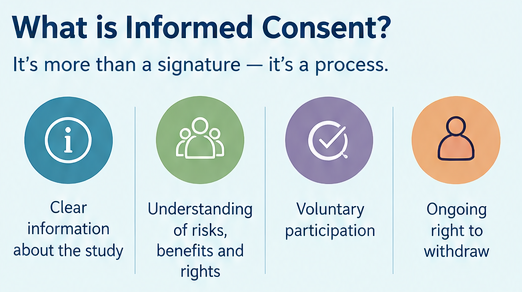
Informed consent is usually portrayed as a clear-cut rule that is, tell the participants what will happen, obtain their agreement, and then carry on. However, everybody who has conducted a study knows that the line is seldom so clear, and the figures confirm this.
In the fields of social psychology, behavioural economics, and platform research, there is always a real tension that every researcher has to come to terms with: it isn't deception versus no deception. It's how much, about what, disclosed to whom, and with what safeguards.
of Milgram's original participants delivered the maximum 450-volt shock when ordered to continue (Milgram, S., 1963).
planned days the Stanford Prison Experiment actually ran before being shut down (Zimbardo, P. G., 1973).
Facebook users whose news feeds were secretly manipulated in the 2014 emotional-contagion study (Kramer, A. D. I., Guillory, J. E., & Hancock, J. T., 2014).
WHY DECEPTION EXISTS IN RESEARCH AT ALL?
Some human behaviours are difficult to study accurately when participants know exactly what the researcher is looking for. For example, if people are told, ‘We are testing how you respond to group pressure’, they may consciously change their behavior. Their responses may be very different from how they would behave if they just thought that they were participating in a general perception task.
That’s the primary reason researchers use deception at times. The idea is that certain aspects of human behavior can only be watched when the participants are not aware of what is being watched.
Even now, in some studies, the researchers use fairly mild forms of deception, such as:
- Using a cover story to hide the specific variable or behaviour being measured.
- Using confederates who appear to be fellow participants but are actually part of the research team.
- Providing false feedback about a participant's performance to examine how they respond to success or failure.
- Keeping participants unaware of their assigned condition, as commonly happens in placebo-controlled trials.
THREE CASES THAT SHAPED THE DEBATE
1961: YALE UNIVERSITY (Milgram, S., 1963)
Milgram's Obedience Studies
Participants were led to believe that they were delivering increasingly painful electric shocks to another person whenever that person answered a memory question incorrectly. In reality, the “learner” was an actor, and no shocks were actually being delivered. The participants, however, did not know this. Their reactions were very real. As the voltage increased, researchers observed sweating, stuttering, nervous laughter, and visible signs of distress. Some participants became extremely agitated as they were instructed to continue.
Despite their discomfort, 65% of the participants continued all the way to the maximum 450-volt setting when the experimenter calmly instructed them to proceed. Not a single participant stopped before reaching 300 volts.
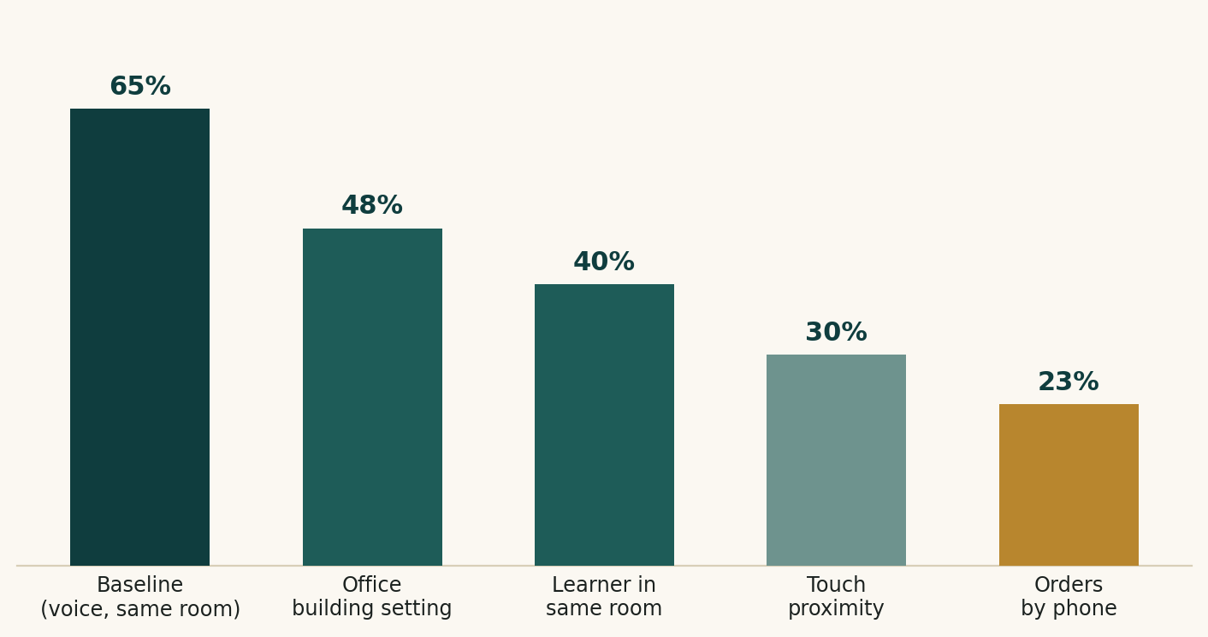
Obedience fell as the authority figure lost proximity and the “learner” gained humanity (Milgram, S., 1963).
1971: STANFORD UNIVERSITY (Zimbardo, P. G., 1973)
The Stanford Prison Experiment
24 college-aged men were randomly assigned to play either “guards” or “prisoners” in a mock prison set up in the basement of Stanford University. Philip Zimbardo, who led the study, took on the role of superintendent rather than remaining a neutral observer. The experiment was originally planned to last two weeks.
Within just a few days, some of the guards became increasingly abusive, while several prisoners experienced severe anxiety, crying, and signs of emotional distress. Five prisoners were released early because of the level of distress they were experiencing. The study was eventually stopped after only six days; just 43% of the planned two-week duration.
2012–2014: FACEBOOK & CORNELL UNIVERSITY (Kramer, A. D. I., Guillory, J. E., & Hancock, J. T., 2014)
The “Emotional Contagion” Experiment
For one week in January 2012, researchers altered the News Feeds of 689,003 Facebook users about 0.4% of the platform’s user base at the time. They quietly reduced the amount of either positive or negative content shown to each group and then examined whether this affected the tone of the users’ own posts.
The researchers reported that emotional expression could spread between users even without direct interaction. However, participants were not given a separate consent form, were not debriefed afterward, and had no specific opportunity to opt out of the study. Instead, Facebook’s Terms of Service were treated as the basis for consent.
When the study was published in 2014, it sparked widespread debate about research ethics, particularly over whether agreeing to a platform’s general terms of use can really count as informed consent for participation in a psychological experiment.
WHERE THE GRAY AREA ACTUALLY LIVES
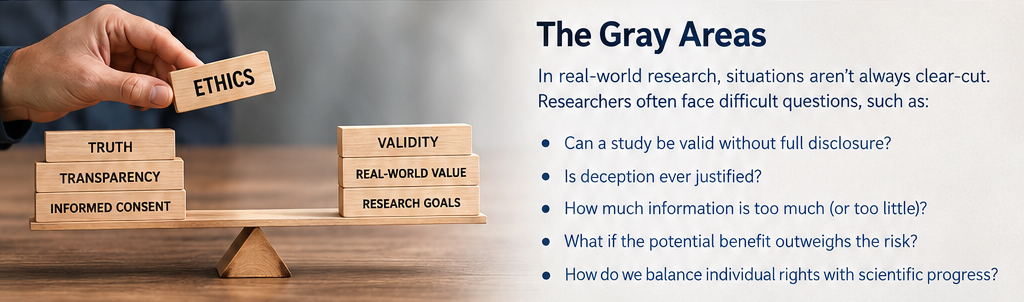
Consent to what, exactly? Participants can agree to take part in “a study on decision-making” without being told the researcher’s exact hypothesis. This is generally considered acceptable in research ethics. Researchers do not necessarily have to reveal what they expect to find; they do, however, need to explain the general nature of the study and any reasonably foreseeable risks.
The ethical concern becomes more complicated when researchers misrepresent not just the specific purpose of a study, but its basic nature.
Risk versus revelation. Milgram’s participants believed they were causing real harm to another person. The distress they experienced was genuine and well documented, and this is one of the main reasons the study would face serious ethical concerns under modern standards.
The distinction that has developed since then is fairly straightforward: deception may sometimes be used to hide the true purpose of a study, but it should not be used to create serious or unnecessary psychological harm.
Debriefing works only if it's substantive. A rushed disclosure at the end of a session doesn't undo the fact that someone made decisions, or experienced distress, under false pretenses.
Institutional versus felt ethics. An ethics committee may approve a study because it meets the formal requirements of an ethical code. But that does not necessarily mean participants will feel that they were treated fairly or honestly.
A study can be technically compliant and still leave someone feeling manipulated or misled. Following the rules and maintaining participants’ trust are not always the same thing. That gap matters because it can lead to damage to relationships, trust, and the researcher’s reputation even when no formal ethical rule has actually been broken.
An online study where full disclosure would ruin the manipulation
THE SETUP
A researcher wants to test whether a subtle framing effect changes how people rate a product or a policy—the kind of effect that only shows up if participants don't know framing is the thing being measured. Telling them upfront (“we're testing whether wording changes your rating”) would collapse the very effect the study exists to detect.
THE ETHICAL ISSUE
Participants can't meaningfully consent to something they don't know is happening to them. The risk is low mild framing manipulations rarely cause distress but the study still depends on withholding the true purpose, and participants deserve to know that before their data is used in publication.
A RESPONSIBLE APPROACH
Get general consent to “a study on judgment and decision-making” rather than naming the specific manipulation this is standard and accepted, since the risk is minimal. Build an automated, immediate debrief screen at the end of the online session that explains the real purpose in plain language, names the manipulation, and explains why it had to be concealed. Give a one-click option to withdraw the response before it's used in analysis, and provide a contact for questions. Share aggregate findings publicly once the study concludes.
A field study in a community where written consent is suspicious or impractical
THE SETUP
A researcher wants to study wellbeing in a rural or indigenous community where literacy is low, oral tradition carries more weight than paperwork, and signed forms are associated with land disputes, government surveys, or legal proceedings all things people have learned to distrust. Handing someone a consent form to sign can itself feel coercive or alarming, working against the purpose it's meant to serve.
THE ETHICAL ISSUE
Standard informed-consent procedure assumes a literate individual signing a document in a context where that's a neutral, familiar act. When it isn't, insisting on the form anyway prioritizes institutional box-ticking over actually informing anyone the opposite of what consent is for.
A RESPONSIBLE APPROACH
Substitute oral consent, recorded with a witness present or on audio, delivered in the local language by someone the community already trusts. Engage community leaders or a local advisory group before individual recruitment begins, so the study has standing before anyone is approached one-on-one. Where a physical record is required, a thumbprint or verbal audio confirmation can stand in for a signature. This approach is well established in community-based participatory research (CBPR) and is explicitly permitted under most ethics board guidelines as an alternative to written consent when justified in the protocol.
A digital mental health app that collects passive data
THE SETUP
A mental health app passively tracks typing speed, screen time, movement, and sleep patterns in the background to infer mood or detect early signs of relapse. The user agreed to this once, at install, by accepting a long terms-of-use document.
THE ETHICAL ISSUE
A single click at install is a poor stand-in for ongoing, informed consent to years of continuous, intimate data collection especially when that data is used to infer something as sensitive as mental state. Most users can't recall what they agreed to six months in, and the kind of inferences being drawn (mood, relapse risk) are far more sensitive than the raw data (typing speed, GPS pings) makes obvious.
A RESPONSIBLE APPROACH
Treat consent as ongoing rather than a one-time event: re-prompt users periodically, and always when a new data type or new use of existing data is introduced. Provide a plain-language, always-accessible dashboard showing exactly what's being collected and what it's being used to infer not just a legal document. Offer granular controls so a user can opt out of specific data streams (location, but not typing patterns, for instance) without losing the whole app. Set a clear, disclosed data-retention and deletion policy, and make withdrawal genuinely easy rather than technically possible but practically buried.
FRAMEWORKS RESEARCHERS USE
Rather than treating deception as simply permitted or forbidden, most modern ethical frameworks ask researchers to weigh it against a set of conditions before a design is approved:
Necessity
Could the same finding be obtained without deception? If a non-deceptive design produces comparable data, deception is harder to justify.
Proportionality
Is the deception minor, such as withholding a hypothesis, or major, such as fabricating an entire scenario or false personal feedback? Minor deception is far more broadly accepted.
Reversibility of harm
Can any distress caused be fully addressed through debriefing, or does it risk lasting psychological effects?
Right to withdraw retroactively
Can participants, once informed of the deception, decline to have their data used at all?
Vulnerability of the population
Deception involving children, clinical populations, or people in positions of dependency invites far stricter scrutiny than deception involving informed adult volunteers.
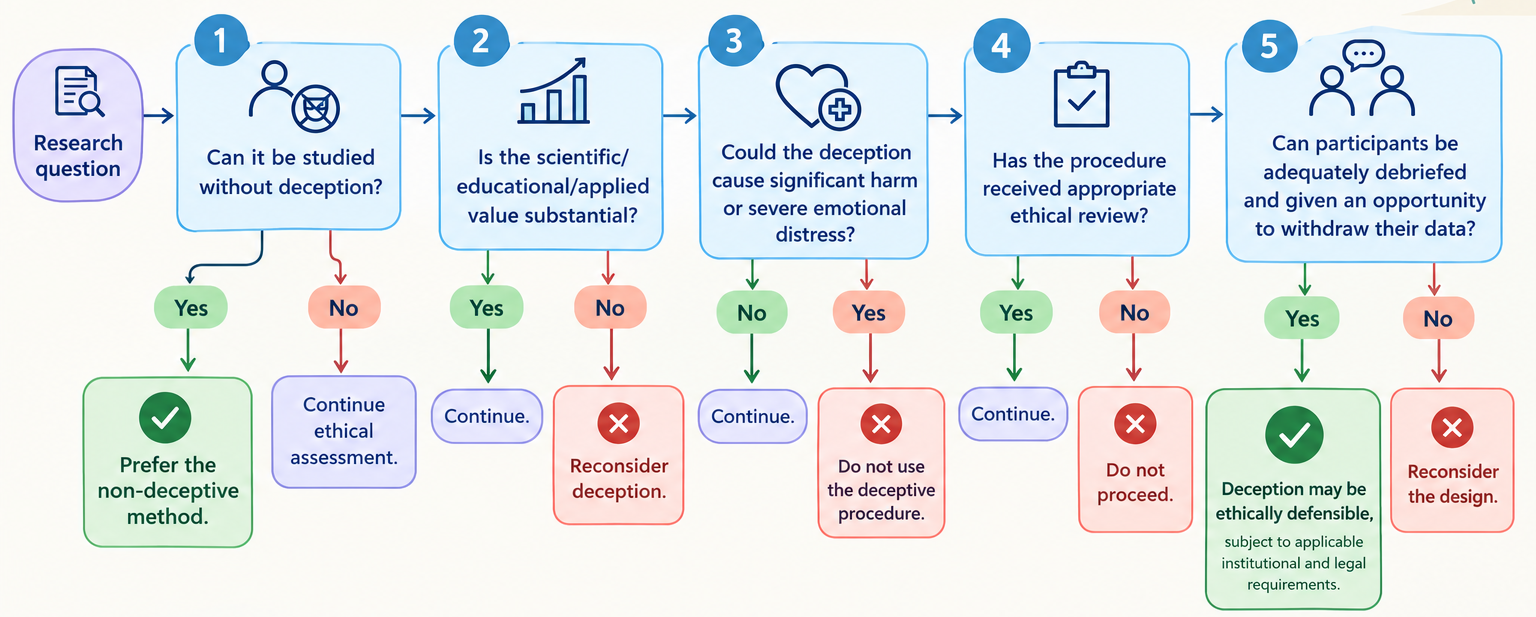
A working principle, not a rulebook
There's no formula that resolves every case, but a useful working principle for researchers navigating this space: deception should be a tool of last resort, proportionate to the knowledge gained, and always paired with a genuine, respectful debrief that treats the participant as someone owed an explanation not someone who was simply handled.
The ethical weight isn't in whether deception was used, but in whether the researcher can defend, in plain language, why no other method would have worked and whether the participant, once told the truth, would still feel their trust had been reasonably placed.
Where Psychology Meets Technology, Ethics Must Lead
As psychological research and assessment increasingly move into digital spaces, technology is opening up new possibilities for how we understand and assess people. But with these opportunities also comes greater responsibility. The ease of collecting and managing large amounts of data should never come at the cost of transparency, informed participation, privacy, or respect for the individual.
At Prasad Psycho Pvt. Ltd., we believe that every response in a psychological assessment represents a person not just a number or a data point. Through DigiConnect, our digital assessment platform, we are working to make psychological assessment more accessible and suited to today’s technology-driven world, while keeping ethical and responsible assessment practices at the heart of what we do.
Because the future of digital psychology is not just about what technology allows us to measure. It is also about how thoughtfully, ethically, and responsibly we choose to measure it.