

Ruchi Parihar
MA Clinical Psychology
15 min read
November 25, 2026
Introduction
You open an app “for a minute.” Forty minutes later you surface, a little dazed, unsure where the time went. That is not a flaw in you. It is what an interface with no ending is built to do.
Newspapers had a last page. Television had credits. The feed has neither. Our attention, though, is finite, and the gap between the two is where the cost shows up. Here it is, in numbers.

Source: DataReportal Digital 2026 Global Overview (via Al Jazeera, 30 Jun 2026). 40 days = 2 h 39 m × 365 days.
That is the global average across 5.66 billion users, more than two in three people on Earth. The reason it adds up so fast is that the phone is always within reach and the feed has no start or finish, so idle moments easily turn into scrolling.
A YEAR, VISUALISED
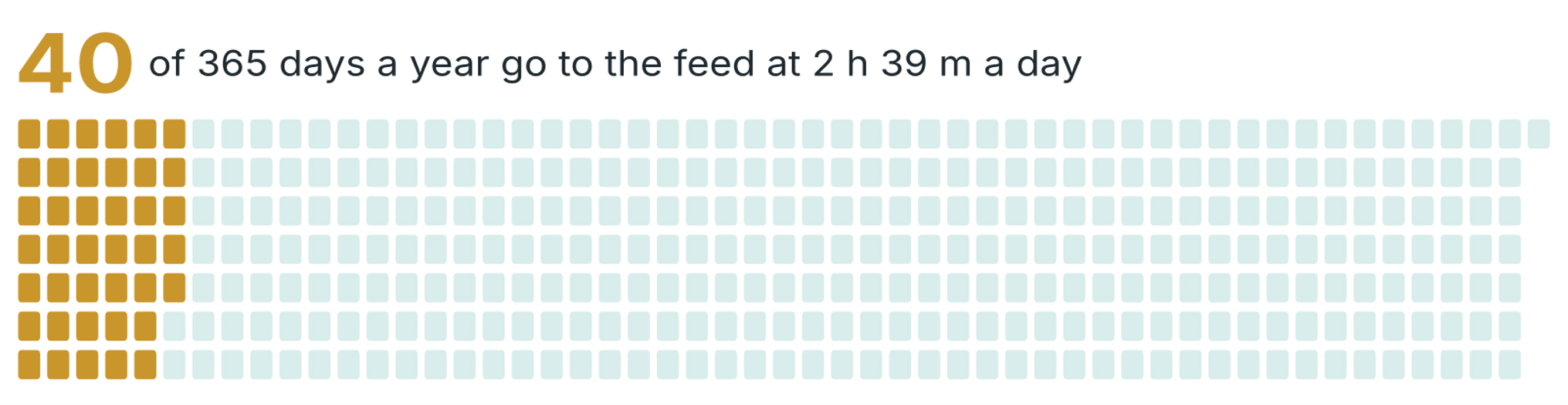
Each square is one day. At 2 h 39 m daily, the feed claims more than 40 full days a year, close to six weeks. The reason it goes unnoticed is that the time arrives in small slices between other tasks, a minute in a queue, a few more before sleep, so no single session feels large. Only when the slices are added up does the real size show.
Why this matters
Time is only half the story. The bigger shift is what the constant stream does to how long we can stay with one thing.
Attention, measured
Psychologist Gloria Mark has timed how long people stay on a single screen since 2003. Back then, the average was about two and a half minutes. By the studies of 2016–2020, it was 47seconds.
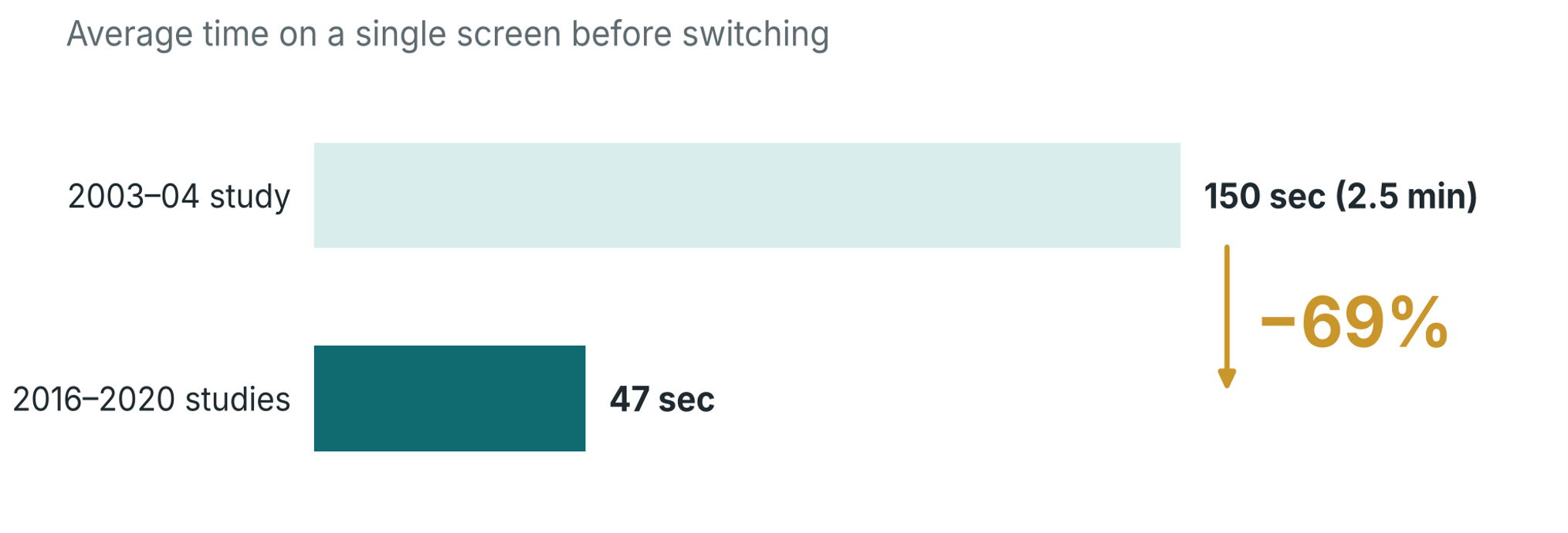
Source: Gloria Mark, UC Irvine; UC Newsroom interview (2024). 2003–04 study vs. average of 2016–2020 studies.
Time on a single screen fell from about 150 seconds to 47, a drop of roughly two-thirds. Mark argues the reason is partly design: the web is built on links, and apps add alerts, each inviting us elsewhere. Partly it is us, as we interrupt ourselves about half the time. The impact compounds, because regaining focus after an interruption can take close to half an hour, so frequent switching leaves little room for deep work.

Source: Gloria Mark, UC Newsroom (2024); platforms per user: DataReportal, April 2026.
Attention isn’t broken. It’s being outbid.
Every app competes for the same few seconds. The more tempting the next thing, the more often we leave the thing we meant to do. Mark’s research found that we interrupt ourselves about half the time, which is why willpower alone is a weak match for a feed designed around novelty.
Try this
Next time you reach for your phone mid-task, notice what you were about to do. Naming the urge for a few seconds often loosens it.
Built to never end
Researchers who study short-video platforms point to three design choices that work together: personalised curation, rapid pace and infinite scroll, which removes the natural stopping cues that once told us “that’s enough.”
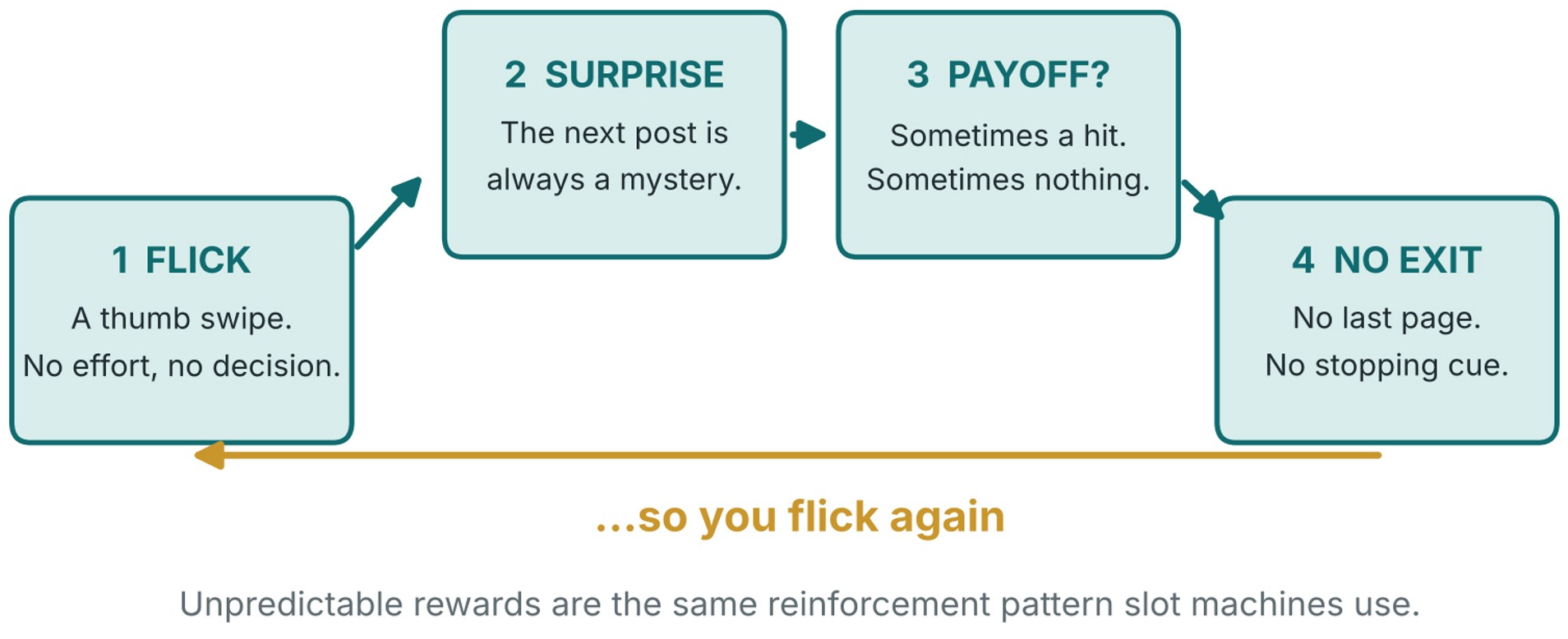
Source: Design components: Springer, Eur. Child & Adolescent Psychiatry review (2026); variable-ratio explanation: Dr Judson Brewer, Brown University.
Every step is tiny, which is the point. A swipe needs no decision, the next post is unpredictable, and nothing signals an end. The reason it holds us is that unpredictable rewards keep the brain checking for the next one, the same pattern behind slot machines. Because the loop comes from the design and not from weak character, breaking it takes a deliberate stopping cue, such as a timer, more than extra willpower.
The slot-machine logic
When rewards arrive unpredictably, the brain keeps checking for the next one. Psychologists call this a variable-ratio schedule, the same pattern that makes slot machines so hard to walk away from. A feed delivers it with a single thumb movement.
The bill
In 2025, a large meta-analysis in Psychological Bulletin pooled the evidence on short-form video, the endless-scroll format behind Reels, Shorts and TikTok.

Source: Nguyen et al. (2025), Psychological Bulletin, Griffith University; reported by Business Standard, Euronews.
The link was strongest for stress and anxiety. Two honest caveats: the findings are correlational, so they don’t prove the videos caused the difficulties, and how compulsively people scrolled mattered more than how long. A related brain-imaging study linked heavier short-video compulsion to lower sensitivity to loss.
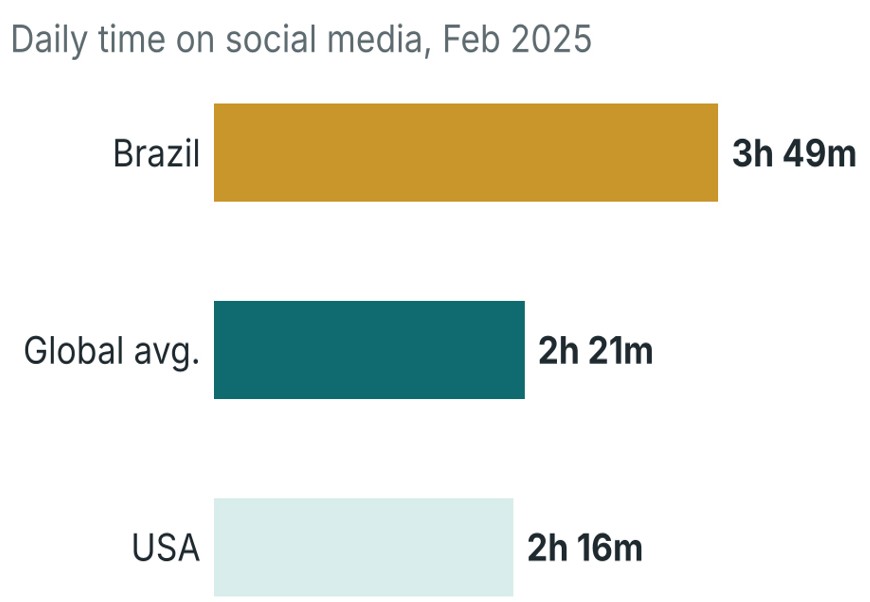
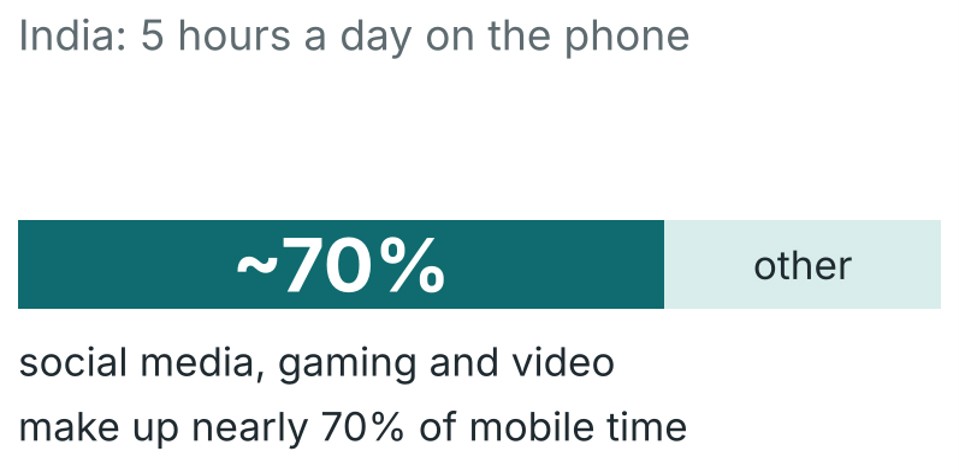
Source: Left: Statista / We Are Social / DataReportal (Feb 2025). Right: EY India Entertainment report (2025), via Bloomberg.
Brazil leads at 3 h 49 m a day, about 1.6 times the global average of 2 h 21 m, with the US just below it at 2 h 16 m. In India, social media, gaming and video take nearly 70% of roughly five hours of daily phone time. EY links this to affordable internet and wider smartphone access: when data is cheap and phones are everywhere, free minutes tend to fill with entertainment.
What it looks like in India
India is among the heaviest mobile-screen markets in the world. Among urban 18–24-year-olds, social media averages over 120 minutes a day, against 97.9 minutes across the wider urban audience.
Source: India Digital Behaviour Report 2025–26 (VTION), via Open Magazine; brain-imaging study: NeuroImage, via Psychology Today.
The takeaway
Heavy scrolling is common, and for most people it is a habit rather than a disorder. The patterns to watch are the ones that crowd out sleep, relationships and tasks that need sustained focus.
Taking the scroll back
You don’t have to quit your phone. Mark’s own advice is not to go cold turkey, but to be intentional. Small structural changes work better than resolve.
Add your own stopping cue
Set a timer before you open a feed. Mark recommends time limits for activities that tend to trap us.
Add friction
Move feed apps off the home screen or log out after each visit. A few extra taps break the autopilot.
Decide before you open
Name what you’re opening the app for. When that’s done, close it.
Protect a single-task block
Keep one stretch of the day phone-free, so attention can rebuild toward longer than 47 seconds.
Rest on purpose
Mark suggests meditation to wind down after intense information processing; easy, engaging breaks work too.
Notice, don’t judge
Strengths-based change starts with curiosity: when do I scroll, and what am I really after?
CONCLUSION
The infinite feed has not made us less capable. An interface with no ending competes for our attention around the clock, and the costs are measurable: shorter stretches on a single screen, weeks of every year in the feed, and stronger links to stress and anxiety among heavy users. So are the remedies. A stopping cue, a little friction and a clear reason for opening the app give attention back its edges.
The feed is infinite.
Your attention is yours to spend.
SOURCES
- Gloria Mark, UC Irvine, UC Newsroom (2024): universityofcalifornia.edu/news/how-sharpen-your-attention-and-meet-your-goals-2024
- Data Reportal Digital 2026, via Al Jazeera (30 Jun 2026): aljazeera.com/news/2026/6/30/social-media-calculator-how-much-of-your-life-is-spent-on-social-media
- Statista / We Are Social / DataReportal, daily social media time (Feb 2025): statista.com/statistics/433871/daily-social-media-usage/
- Nguyen et al. (2025), Psychological Bulletin, meta-analysis of 71 studies: business-standard.com/health/short-video-use-focus-anxiety-cognition-mental-health-study-125112400421_1.html
- Short-form video design (infinite scroll, curation, pace): link.springer.com/article/10.1007/s00787-026-03083-7
- Variable-ratio reinforcement: Dr Judson Brewer, drjud.com/digital-addiction/tiktok-addiction-brain/
- Loss-aversion study (NeuroImage): psychologytoday.com/us/blog/social-instincts/202509/2-signs-short-videos-are-changing-your-brain
- EY India media report (2025): bloomberg.com/news/articles/2025-03-27/indians-spent-1-1-trillion-hours-on-smartphones-in-2024-ey-says
- VTION India Digital Behaviour Report 2025–26: openthemagazine.com/business/young-indians-spend-over-2-hours-daily-on-social-media-outpacing-national-average-report
- Platforms per user (DataReportal, Apr 2026): colorlib.com/wp/social-media-statistics/