

Ruchi Parihar
MA Clinical Psychology
15 min read
October 12, 2026
Beyond The Examination Hall
In September 2026, a second-year student at IIT Bombay died by suicide after being found using a phone during an exam, the institute said. It was the third reported suicide on the campus in seven months. More than 400 students gathered in protest, and mid-semester exams were postponed. The institute has asked everyone to avoid speculation while the police investigation continues.
This post is not about who was right or wrong in that exam hall. It is about what a third loss in seven months tells us about how we notice, and support, students who are quietly struggling.
reported suicides at IIT Bombay in 7 months (Feb–Sep 2026)
students died by suicide in India in 2023
students every day, on average
The seven months on one campus
- February 2026: A second-year student died by suicide in a hostel.
- July 2026: A 20-year-old second-year BTech student died shortly after the new semester began.
- September 2026: A second-year student died after the exam incident. More than 400 students protested, the director met them late that night, and exams were postponed.
Each of these was a person with friends, family and plans. Counting them is not about statistics. It is about asking what a community can notice sooner.
Not Just One Campus: The National Picture
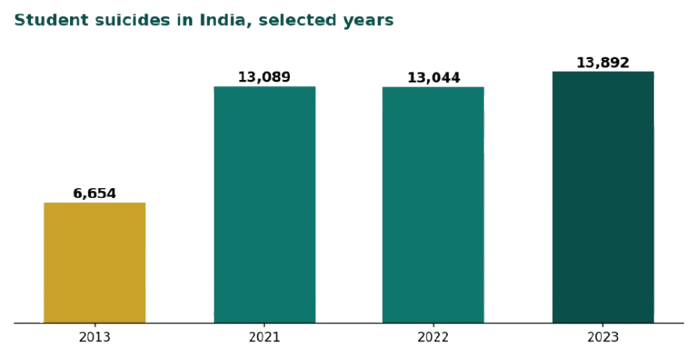
Source: NCRB data as reported by IC3 Institute and Careers360. Selected years only. NCRB counts are based on police FIRs and are believed to under-report.
Over the decade to 2022, student suicides roughly doubled from 6,654 to 13,044. NCRB figures show a 72.9% rise from 2014 to 2023, with students now 8.1% of all suicide deaths. Student cases have grown about 4% a year, twice the pace of suicides overall.
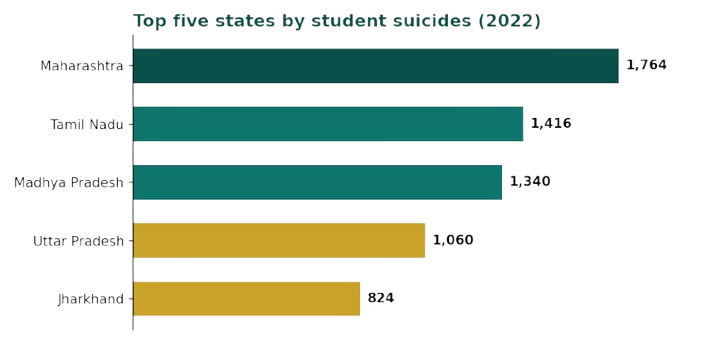
These five states accounted for about 49% of the national total in 2022. In 2023, Maharashtra again recorded the most (2,046, or 14.7%).
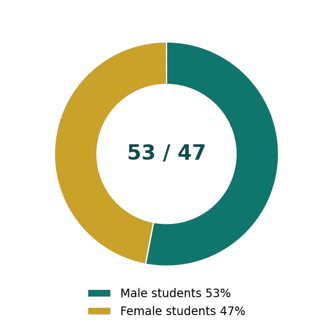
Source: NCRB data via IC3 Institute.
The Iceberg Beneath the Exam
It is tempting to blame a single event: a failed paper, a disciplinary incident, a breakup. But suicide is rarely caused by one thing. A crisis usually lands on top of pressures that have built quietly for a long time.
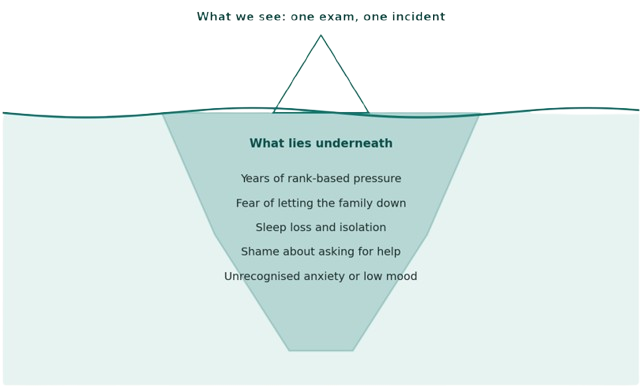
Illustrative model, not a clinical diagram.
Think about the road to a place like IIT: years of coaching, mock-test percentiles, and the belief that one entrance exam decides a life. Then the student arrives among hundreds who were all at the top, and “average” starts to feel like failure. In that setting, a setback does not feel like a setback. It can feel like proof of a long-held fear: I’m not good enough, and I’ve let everyone down.
Shame keeps distress hidden. The most dangerous thing a struggling student can believe is that nobody can be told.
That is why the way institutions handle academic misconduct and failure matters. Rules and consequences are legitimate. But whether the process is private, whether it is paced humanely, and whether a human being checks in on the student as a person can shape how the experience lands.
What the protests are really asking
The students on the road that night were not only grieving. They were asking whether anyone is listening before a crisis rather than after. Whatever the investigation finds, these questions apply to every campus in India:
Is counselling trusted?
A counsellor on paper is not the same as students feeling safe to walk in. Wait times and confidentiality fears matter.
Who notices early?
Roommates, wardens and teaching assistants often see changes first, if they know what to look for.
Is there a wellbeing step?
Any serious academic or disciplinary process should include a human check-in.
Are peers equipped?
Most students tell a friend first. Friends need to know what to say and where to go next.
Early signs worth noticing
Changes in routine
Sleeping much more or less, missed classes, skipped meals, falling grades.
Pulling away
Dropping friends, staying in the room, going quiet in group chats.
Hopeless talk
“What’s the point?”, “I’m a burden”, or giving away belongings.
After a blow
A sudden change in mood following a failure, accusation or loss.
What good support looks like
Normalise help-seeking
When leaders and seniors talk openly about stress, asking for help gets cheaper.
Make counselling easy
Short waits, anonymous and online options, clear confidentiality.
Train gatekeepers
Wardens, faculty and mentors who can spot signs and connect a student to help.
Screen thoughtfully
Validated psychometric tools can flag quiet distress for a trained professional to follow up. A score is never a diagnosis.
Make setbacks survivable
Flexible policies and advising so one result does not feel like everything.
Bring families in
Parents can be part of the safety net when institutions talk to them honestly.
Myths and Facts
| Myth | Fact |
|---|---|
| Asking someone about suicide will put the idea in their head. | Asking directly, calmly and without judgement is more often a relief. Listen, don’t lecture, and help them reach a professional. |
| People who talk about it are just seeking attention. | Talk of hopelessness is a signal to take seriously. Reaching out is often a way of asking for help. |
| It was caused by that one exam. | A trigger is usually the last of many pressures, not the cause. Reducing a life to one cause also makes it harder to see what could be changed. |
| Counselling is only for people who are seriously ill. | Support works best early. Seeking it is a strength, not a weakness. |
How we talk about it matters
Responsible coverage avoids sensational detail, avoids presenting suicide as a solution, and treats the person with dignity. It points readers to help. If someone you know seems withdrawn, hopeless or different, ask how they are, and keep asking.
A student is never only a rank, a grade or a record. Our job is to make sure each of them knows that, long before the examination hall.
If you or someone you know needs support
Support begins with noticing. At PRASAD PSYCHO, we offer assessments that screen individuals, helping schools, colleges and counsellors identify students who may be experiencing emotional difficulty so that a trained professional can follow up with care.
Screening is not a diagnosis. It is a way of making sure quiet distress is noticed early, and a starting point for a supportive conversation.
Sources: IIT Bombay incident reporting: Khaleej Times, Gulf News (Sept 2026), ETV Bharat/PTI (July 2026). Student suicide data: NCRB Accidental Deaths and Suicides in India 2023 (via Careers360); IC3 Institute report “Student Suicides: An Epidemic Sweeping India” (via PTI, 2024). Helpline numbers to be verified before publication.